
Carnegie Mellon University & University of Porto
I am a PhD candidate in Software Engineering at Carnegie Mellon University and the University of Porto (CMU Portugal dual degree), graduating in August 2026.
Developers naturally think and communicate in sketches, yet software is built purely through text. My research makes sketches a first-class interface to code, across three big ideas:
- Code generation from sketches — a Visual Code Assistant that turns hand-drawn ML sketches into runnable notebooks (ICSE'25);
- Code explanation with sketches — agentic systems that generate visual documentation from source code: VisDocSketcher (arXiv'25) and JupyterDraw (preprint'26), whose diagrams help reviewers catch flaws in AI-generated code;
- Code–sketch co-evolution — Visual Loop, a development environment that keeps code and sketches in bidirectional synchronization (FORGE'26).
Running through all three is the question of how to evaluate generated artifacts at scale, from ensemble LLM-as-judge metrics calibrated against human raters (ASE'25) to reference-free scoring of diagrams with no ground truth (AutoSketchEval). See all publications
Open to Research Scientist / Research Engineer roles in AI for software engineering, agents, and reasoning.
Warning
Problem: The current name of your GitHub Pages repository ("Solution: Please consider renaming the repository to "
http://".
However, if the current repository name is intended, you can ignore this message by removing "{% include widgets/debug_repo_name.html %}" in index.html.
Action required
Problem: The current root path of this site is "baseurl ("_config.yml.
Solution: Please set the
baseurl in _config.yml to "Education
-
 Carnegie Mellon UniversitySchool of Computer Science
Ph.D. in Software Engineering (CMU Portugal)Aug. 2021 - Aug. 2026 -
 University of PortoPh.D. in Computer Science (CMU Portugal)
Dual DegreeAug. 2021 - Aug. 2026with Rui Abreu -
 University of MinhoB.Sc. + M.Sc. in Computer Science (Intelligent Systems & Data Science)Sep. 2015 - Aug. 2021
Experience
-

-
 HubsData Science Intern, Amsterdam2021
 -
 Instituto Superior TécnicoJunior Software Engineer2020 - 2021
Honors & Awards
-
CMU Portugal Fellowship2021 - 2026
-
Huawei Scholarship — Top Students in Portugal (top 1%)2023
-
FCT Research Fellowships (×2)2018 - 2021
News
Selected Publications (view all )
“Bring the image back!” An Empirical Study of Visual Summaries in Code Review
Luís F. Gomes, Xin Zhou, Vincent Hellendoorn, Jonathan Aldrich, Rui Abreu, David Lo
Preprint — under review 2026
JupyterDraw automatically generates informal diagrams from Jupyter notebooks to help reviewers catch silent flaws (data leakage, improper evaluation) in AI-generated code. A controlled experiment with 26 participants found the visual overview caught +0.50 more flaws per task than a textual one, raising the share of reviews catching both planted flaws from 29% to 67%.
“Bring the image back!” An Empirical Study of Visual Summaries in Code Review
Luís F. Gomes, Xin Zhou, Vincent Hellendoorn, Jonathan Aldrich, Rui Abreu, David Lo
Preprint — under review 2026
JupyterDraw automatically generates informal diagrams from Jupyter notebooks to help reviewers catch silent flaws (data leakage, improper evaluation) in AI-generated code. A controlled experiment with 26 participants found the visual overview caught +0.50 more flaws per task than a textual one, raising the share of reviews catching both planted flaws from 29% to 67%.
Visual Loop: Bridging the Cognitive Gap in Software Development Through Visual-AI Collaboration
Luís F. Gomes, Xin Zhou, David Lo, Rui Abreu
International Conference on AI Foundation Models and Software Engineering (FORGE) 2026
A vision paper introducing Visual Loop, a continuous visual development environment that keeps code and informal sketches in bidirectional synchronization. The prototype connects a code editor with a tablet-based visualization workspace, where freehand sketches are interpreted by multimodal LLMs grounded in static analysis and visual context — turning sketching from passive documentation into an active interface for software evolution.
Visual Loop: Bridging the Cognitive Gap in Software Development Through Visual-AI Collaboration
Luís F. Gomes, Xin Zhou, David Lo, Rui Abreu
International Conference on AI Foundation Models and Software Engineering (FORGE) 2026
A vision paper introducing Visual Loop, a continuous visual development environment that keeps code and informal sketches in bidirectional synchronization. The prototype connects a code editor with a tablet-based visualization workspace, where freehand sketches are interpreted by multimodal LLMs grounded in static analysis and visual context — turning sketching from passive documentation into an active interface for software evolution.
SE-Jury: An LLM-as-Ensemble-Judge Metric for Narrowing the Gap with Human Evaluation in SE
Xin Zhou, Kisub Kim, Ting Zhang, Martin Weyssow, Luís F. Gomes, Guang Yang, Kui Liu, Xin Xia, David Lo
CORE A* International Conference on Automated Software Engineering (ASE) 2025
SE-Jury is an LLM-as-ensemble-judge metric that combines five distinct evaluation strategies to assess the functional correctness of generated software artifacts, with a dynamic team selection mechanism that picks the optimal subset of evaluators — cutting LLM API costs by ~50% while maintaining evaluation accuracy.
SE-Jury: An LLM-as-Ensemble-Judge Metric for Narrowing the Gap with Human Evaluation in SE
Xin Zhou, Kisub Kim, Ting Zhang, Martin Weyssow, Luís F. Gomes, Guang Yang, Kui Liu, Xin Xia, David Lo
CORE A* International Conference on Automated Software Engineering (ASE) 2025
SE-Jury is an LLM-as-ensemble-judge metric that combines five distinct evaluation strategies to assess the functional correctness of generated software artifacts, with a dynamic team selection mechanism that picks the optimal subset of evaluators — cutting LLM API costs by ~50% while maintaining evaluation accuracy.
VisDocSketcher: Towards Scalable Visual Documentation with Agentic Systems
Luís F. Gomes, Xin Zhou, David Lo, Rui Abreu
arXiv preprint 2025
An agentic LLM system that generates high-level visual documentation from source code, paired with AutoSketchEval — a reference-free evaluation framework (inspired by autoencoder reconstruction) that scores diagram quality with no ground truth, reaching AUC > 0.87 across 1,000 Jupyter notebooks.
VisDocSketcher: Towards Scalable Visual Documentation with Agentic Systems
Luís F. Gomes, Xin Zhou, David Lo, Rui Abreu
arXiv preprint 2025
An agentic LLM system that generates high-level visual documentation from source code, paired with AutoSketchEval — a reference-free evaluation framework (inspired by autoencoder reconstruction) that scores diagram quality with no ground truth, reaching AUC > 0.87 across 1,000 Jupyter notebooks.
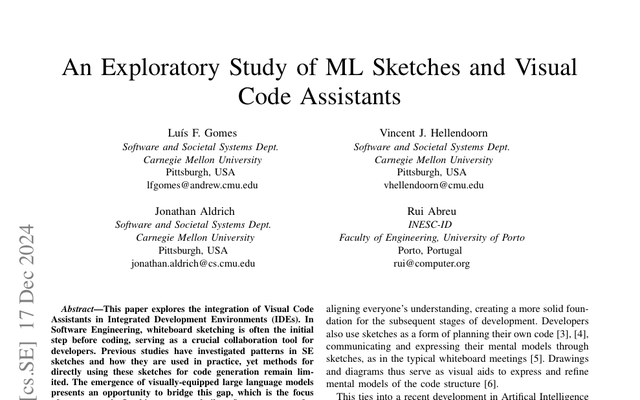
An Exploratory Study of ML Sketches and Visual Code Assistants
Luís F. Gomes, Jonathan Aldrich, Rui Abreu, Vincent Hellendoorn
CORE A* International Conference on Software Engineering (ICSE) 2025
A VSCode assistant that turns hand-drawn ML workflow sketches into runnable Jupyter notebooks (79% structural accuracy, 49% reduction in coding), with a 19-participant developer study and an automated LLM-as-judge pipeline benchmarking sketch-to-code across GPT-4o, Gemini Pro, and Claude.
An Exploratory Study of ML Sketches and Visual Code Assistants
Luís F. Gomes, Jonathan Aldrich, Rui Abreu, Vincent Hellendoorn
CORE A* International Conference on Software Engineering (ICSE) 2025
A VSCode assistant that turns hand-drawn ML workflow sketches into runnable Jupyter notebooks (79% structural accuracy, 49% reduction in coding), with a 19-participant developer study and an automated LLM-as-judge pipeline benchmarking sketch-to-code across GPT-4o, Gemini Pro, and Claude.